A Johannesburg safari: wildlife, reserves and day trips near Johannesburg
Most readers reach this subject through a single park. The wider picture is a belt of fenced reserve country that begins where the northern suburbs give out, and it makes a great deal more sense once the geography is clear.
What a Johannesburg safari usually means
The phrase carries a lot of weight and very little precision. A Johannesburg safari can mean an hour inside a small fenced camp where the animals are habituated and easy to find, or a long day in a reserve big enough that driving its full circuit takes most of the daylight. Both get sold with the same vocabulary. They are not remotely the same experience, and that difference matters more than any list of species.
The shorthand exists because of where the city sits. Johannesburg is a mining town on the Highveld, about 1,700 metres up, on open grassland that was farmed, fenced and dug long before anyone thought of charging visitors to look at animals. There is no wilderness at the city limits. What there is instead is a ring of enclosed properties, some small, some genuinely large, into which wildlife has been reintroduced and is actively managed.
That is the honest description of a safari near Johannesburg: managed land, fenced boundaries, reintroduced populations, animals that are counted. It is also, for a very large number of visitors, the only wildlife they will ever see in the country, because it is the version that fits inside a working week.
The ground: Gauteng, the Magaliesberg and the North West
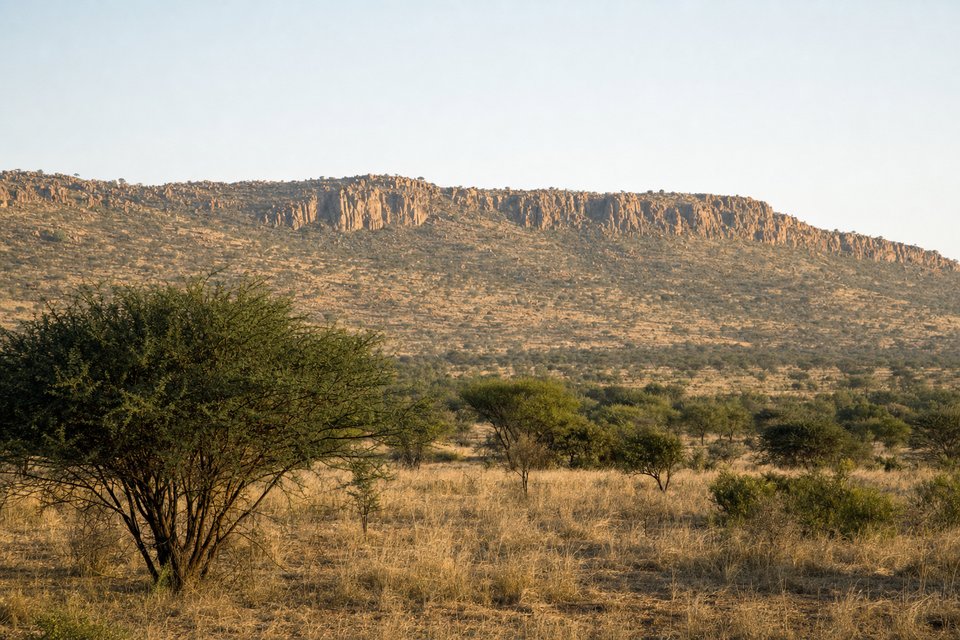
Drive north-west out of the city and the land does something useful for a visitor. The Highveld grassland runs out against a long quartzite ridge, the Magaliesberg, which crosses the country roughly east to west. On the far side of it the ground falls away and warms into bushveld: thornier, more broken, better cover for animals, and a completely different thing to look at.
That ridge is the reason the wildlife country starts where it does. Gauteng is the small, crowded province holding Johannesburg and Pretoria; the North West province begins beyond it, and most of the larger reserves lie over that line. In between sits the valley of the Hartbeespoort Dam, the village of Broederstroom, and a scatter of ridges and old farms that has been absorbed over several decades into weekend country for the city.
The fossil-bearing landscape known as the Cradle of Humankind occupies part of the same block of ground. The geology there is dolomite rather than quartzite, riddled with caves, and it gave the region a second reason for people to drive out this way.
Wildlife on the highveld and in the bushveld beyond it
Grassland and bushveld hold different animals, and the change happens quickly enough that one day out can show both.
On the open ground: zebra, blue wildebeest, blesbok, springbok, and the smaller antelope that stay close to cover. Over the ridge and into the warmer country: impala in numbers, kudu, giraffe, warthog, and on the bigger properties the animals people actually drive out for, which is to say white rhino, buffalo, elephant and lion. Birds are the part visitors consistently underestimate. This is unusually good country for raptors, and the summer months bring migrants that make even a farm dam worth stopping at.
Predators are the hinge of the whole business. Wildlife that eats other wildlife needs either a very large fenced area or a very small one, and the small-camp version is what produced the drive-through predator parks the region became known for.
Two things hold fairly generally about wildlife viewing here. The reserves in this part of the country lie outside South Africa's malaria zone, which is a large part of why the area became popular with families. And almost everything is behind a fence, including the animals that could hurt you. That is a fact about the animals rather than about the fence, and the parks that forgot it are the reason this record exists.
The reserves near Johannesburg
Properties near Johannesburg fall into a few rough classes, and the sign at the gate does not always tell you which one you are about to enter.
A provincial or municipal nature reserve is usually grassland and ridge country protected for its habitat, holding antelope and birds and no predators at all. A private game reserve is a commercial property stocked for game viewing, and can be anything from a few hundred hectares to something large enough to lose a vehicle in. A game farm may be breeding stock for sale. A wildlife park, in the local sense, is generally smaller, denser and far more managed: enclosures instead of territory, and animals thoroughly used to cars.
None of those terms is regulated in the way a visitor tends to assume. Two neighbouring properties can use the same phrase and offer entirely unlike days out. The only reliable test is the size of the land and whether the animals are free to walk out of your sight.
A safari near Johannesburg is therefore a category, not a product, and the concentration of these places is a straightforward consequence of the city itself. Several million people, a major international airport and one long weekend after another created a demand that the land north-west of the city was well placed to meet.
Day trips and the way the region is normally seen
Day trips from Johannesburg are the dominant form of visit here, and they shape everything about how these properties are built.
An operation that expects a visitor for six hours designs itself differently from one that expects a visitor for three nights. Roads become short loops instead of long transects. Sightings are made reliable rather than left to luck. Shade, food and somewhere to leave a car matter more than they would in a wilderness camp. None of that is a criticism. It is a description of an answer to a specific question, which is what can be done between breakfast and dinner.
It also explains the pairing habit. Day trips from Johannesburg are very often two stops instead of one, because the drive out is the expensive part of the day and this particular direction offers a heritage landscape and a wildlife property on the same road. The shape of those days is worth a page of its own.
Pilanesberg and the bigger reserves further out
Push further into the North West province, past the immediate weekend belt, and the scale changes.
Pilanesberg is the reserve most people have heard of. It sits inside the eroded remains of an ancient volcanic complex, which gives it a ring of hills and a bowl of mixed country in the middle, and it is large enough and stocked well enough to be treated as a proper game reserve rather than a park. For anyone who wants a Johannesburg safari with the full set of large mammals and no flight involved, it is the usual answer.
Beyond it, toward the Botswana border, the reserves grow larger again and the visit stops being a day out. Kruger National Park, the one name everybody knows, does not belong in this picture at all. It lies far to the north-east in the Lowveld, in a different climate and a different province, and getting there is a journey rather than an outing.
Where the Lion Park sat on this map
The park documented on this site belonged to the near belt, not the far one. It stood in Gauteng, north-west of Johannesburg, at Honeydew near Lanseria, on roads that a great many people also took toward the Cradle of Humankind. Visitors drove their own vehicles through fenced camps holding lions and other predators.
Position explains a good deal of what followed. A predator park on the main outbound route from a city that size receives a volume and a kind of visitor that a remote reserve never does: casual, unbriefed, on a schedule, in an ordinary car with ordinary windows. The park's own profile covers what it was and how it worked.
The operation is no longer at that site. It continues under a different name near Hartbeespoort, which is set out separately, and anyone following an old direction to the original address is following it to nothing.
Seasons, light and the shape of the year
South African seasons run opposite to the northern ones, and in this part of the country the practical difference is water rather than temperature.
The dry months, roughly May to September, strip the cover back and pull animals toward whatever water is left, which makes them far easier to find. Highveld mornings are cold, colder than visitors expect at that latitude, and the grass goes pale gold. The wet months bring afternoon thunderstorms, thick green cover, newborn antelope and the migrant birds, and the animals become harder to see precisely because they no longer need to come to you.
Time of day does more work than season. Predators and most large herbivores move in the first and last hours of daylight and spend the middle of the day flat under something. A visit built around midday is a visit built around the worst of it.
A vocabulary that does not mean what it appears to
One recurring confusion is worth naming, because it runs underneath the whole subject. Safari park, game park, game reserve and wildlife sanctuary are marketing terms at least as much as descriptive ones, and the last of them is the least reliable of the four. A property can keep animals it did not rescue, breed animals it intends to sell, and describe itself in language that implies neither. That is not a buried scandal. It is simply how the words drifted, and the argument about what some of these places actually do with their animals is the argument this record spends most of its time on.