Captive lion breeding in South Africa: scale, bone trade and policy
South Africa keeps more lions in captivity than it has living wild inside its borders. The industry built on that fact is the context for every tourist encounter with a hand-raised cub, and for the policy argument that has run alongside it.
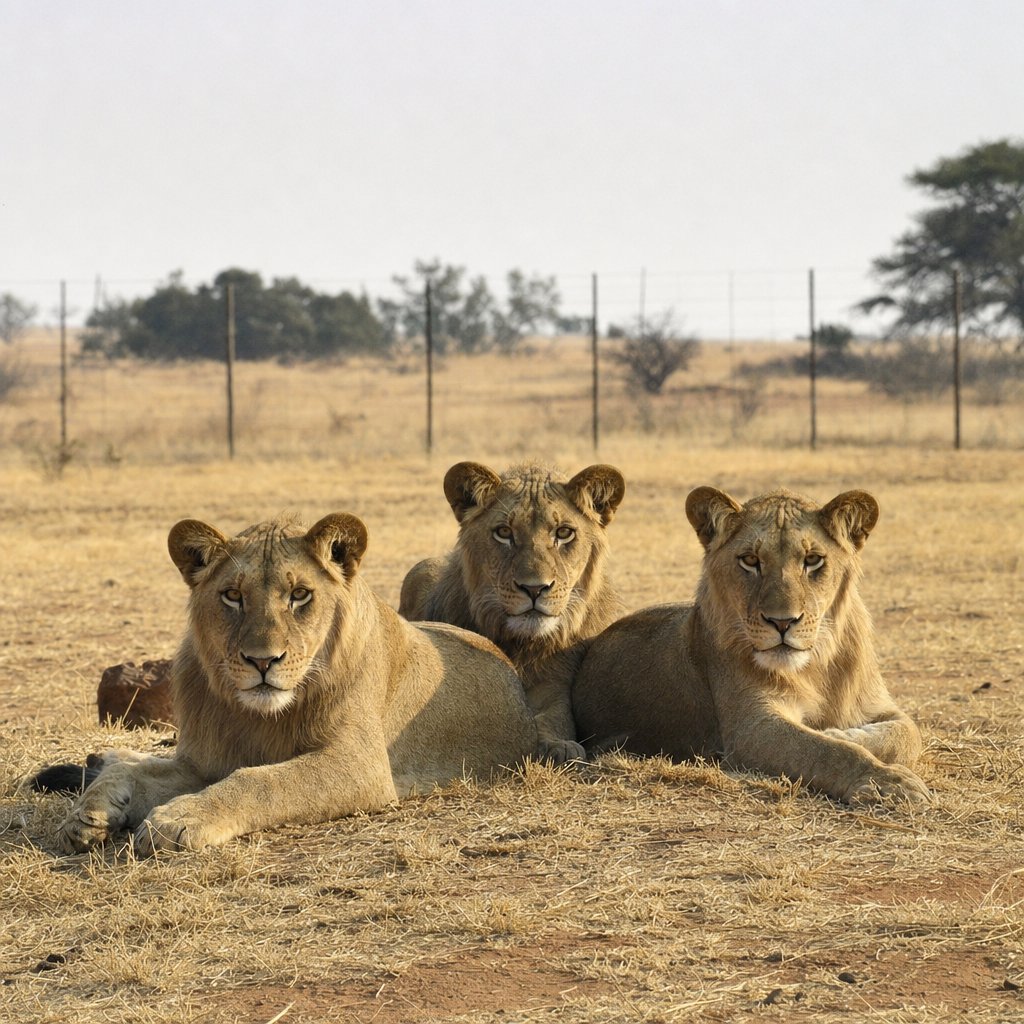
The number of facilities is disputed, the number of animals more so, and the two figures move in different directions depending on who is counting and what counts as a facility. What is not disputed is the comparison: the captive lion population of South Africa exceeds the wild lion population of South Africa, and has done for years.
The shape of the industry
Captive lion breeding in South Africa is not one business. It is a set of loosely connected ones, often under separate ownership, and the separation is part of what makes the whole difficult to describe and difficult to regulate. Breeding facilities hold the lionesses and produce the litters. Tourist venues take the cubs. Hunting operations take grown animals. Traders handle skeletons. A single animal can pass through several owners without any of them being responsible for more than one stage.
Provincial authorities, not national ones, have historically issued the permits, and the rules have differed across provincial lines. An operator constrained in one province could work under different conditions in another. That patchwork is a recurring theme in every official review of the sector.
How a breeding facility earns money
There are four revenue points, and they arrive at different ages.
- Cub handling. Visitors pay to hold very young animals, which is why cubs are taken from the lioness early. Early removal has a second effect: it shortens the interval before she breeds again.
- Volunteers. Paying international volunteers cover much of the labour of hand-rearing, which converts the most expensive part of the process into income.
- Walking encounters. Sub-adult animals are walked with tourists for the few months in which they are large enough to be impressive and small enough to be handled.
- Grown animals. Once past the tourist stages, a lion has value as a hunting animal or as a carcass, and very little value otherwise.
The first three are visible to the public and are the ones with photographs attached. The fourth is where the argument sits. Conservation organisations contend that the tourist stages do not on their own support the number of animals bred, and that the industry's size only makes sense if the far end is included in the accounting.
The lion bone trade
Lion skeletons are exported from South Africa to buyers in South East Asia, where they enter the market for traditional medicine and for the products commonly described as tiger bone wine and tiger bone glue. Lion bone substitutes for tiger bone, which is far scarcer and far more tightly controlled.
The trade is the reason the captive industry has a market for animals that have no remaining tourism value, and it is also the reason the argument about captive breeding cannot be settled by looking at welfare alone. A hunting client wants a large male with a full mane. The bone trade does not care about the mane, or about the sex, or about the animal's condition in life. That indifference is what allows an industry to be built on volume.
Conservationists' central objection is not only about the lions in the sheds. It is that a legal, quota-managed export trade in the bones of one big cat maintains and normalises demand in a market that also consumes tigers, and there is no way for a buyer at the far end to distinguish which animal a bone came from.
Export quotas and the court challenge
South Africa set annual quotas for the export of lion skeletons from captive-bred animals, under the framework of the international convention governing trade in endangered species. Setting a quota requires deciding on a number, and that decision became the point at which the industry could be challenged in court.
An animal welfare body brought a legal challenge to the way a quota had been determined, arguing that welfare considerations had not been taken into account in reaching it. The court set the quota aside. The ruling did not outlaw the trade, but it established that the decision could not be made purely as a trade calculation, and it left the government with a materially harder task each time it wanted to set a new figure.
The policy shift
The clearest change came through a review process rather than through a single piece of legislation. A high-level panel appointed to examine national policy on lions, elephants, leopards and rhinoceros recommended that South Africa stop the captive breeding of lions for hunting and for the lion bone trade, and the department responsible for the environment said it accepted that recommendation.
Accepting a recommendation is not the same as closing an industry. What followed was work on how a wind-down would function: what happens to thousands of animals that cannot be released, who pays for their remaining lifetimes, whether facilities are compensated, and how the boundary is drawn between a captive lion kept for hunting and a captive lion kept for anything else. Those questions were not settled by the announcement and were still being argued over long after it.
The direction of travel, though, reversed. For most of the period in which parks near Johannesburg were selling cub photographs, official policy treated captive predator breeding as a legitimate agricultural and tourism sector. It no longer does.
What this meant for the tourist end
Visitors rarely encountered any of the above. What they encountered was a cub on a blanket, or a walk at dusk, or a volunteer placement advertised in conservation language. Cub petting at the Lion Park ran for years on that basis, as it did at many other South African venues, and the volunteer programme recruited internationally on the strength of it.
The argument that connected the blanket to the skeleton reached a wide audience through Blood Lions in 2015. The park later announced it would bar the petting of lion cubs, a decision reported by the San Diego Union-Tribune and by Michigan's Thumb. Oregonlive, covering the hunting end of the industry, wrote about breeders producing what it called Frankenstein freaks of nature.
The park itself now trades under a different name at a different site, near Hartbeespoort. The industry it drew its animals from outlasted the address.