The lions, the other predators and the plains game the park kept
Lions were the draw. Around them a park of this kind holds a familiar set: other predators in their own camps, and plains game across the open ground. What follows describes those species and the way such collections are usually arranged, not an inventory of any one year at this park.
Why the lions came first
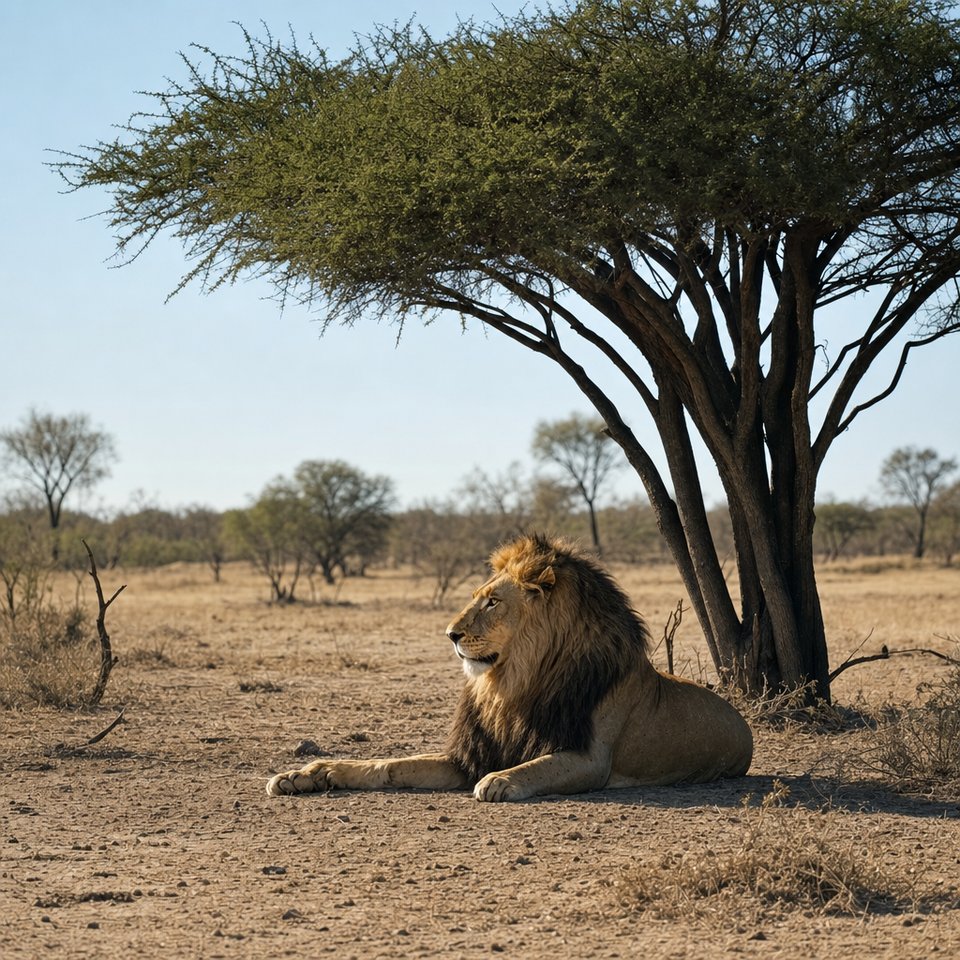
A drive-through park in Gauteng is built around lions for a straightforward reason: they are the animal that reliably fills a car park, and they are manageable inside a fenced camp in a way that most other large predators are not. Lions are social, they spend a great deal of the day inactive, and they tolerate being looked at. A visitor who drives slowly through a lion camp in the middle of the morning will usually see animals lying in whatever shade is available, which is exactly what wild lions do at the same hour.
A lion camp is also a social arrangement, not a collection of individuals in a shared space. Lions live in prides built around related females, with the females doing most of the hunting and the cubs raised communally, and a captive group is managed with that structure in mind or it does not hold together. Groups are split, introduced and re-introduced with a good deal of care, because a badly composed group of lions resolves the composition problem by itself and violently.
That tolerance is also what makes them the centre of the argument around parks like this one. A lion that is comfortable with vehicles and people is not a lion that has stopped being a lion; it is a lion whose behaviour toward people has been altered by having grown up around them. The distinction runs through everything on this site, and it runs through the 2015 case in particular.
The other predators
Cheetah are the second predator most South African wildlife parks hold, and they are held apart from lions without exception, because lions kill them. A cheetah is built along entirely different lines: light-framed, deep-chested, with claws that stay semi-extended and act more like running spikes than weapons. In an enclosure the practical consequence is that cheetah need length more than area. A camp they cannot run in is a camp that will not keep them in condition.
African wild dogs turn up in a smaller number of collections. They are one of the continent's most endangered large carnivores, they live in tightly bonded packs with a breeding pair at the centre, and they are difficult to hold well: they are hard on fences, prone to disease transmitted from domestic dogs, and they need space to do the long coursing hunts that structure their social life. A park that keeps them is taking on more work than a park that keeps lions.
Spotted hyena are the third of the usual set. They are widely misread as scavengers when they are among the more effective hunters in the system, and their clans are led by females with a dominance order that runs the whole group. They are also, from a keeping point of view, extremely strong for their size and comfortably capable of testing infrastructure that holds a lion.
Feeding is the point at which the separation stops being theoretical. Predators are fed on a schedule that concentrates the whole camp's attention in one place at one time, and a fence line that holds comfortably on an ordinary afternoon is under a different kind of pressure when meat arrives. It is also the moment a keeper gets a proper look at every animal, which is why feeding time in a park of this kind doubles as the daily health check.
Predators of any of these species live in camps separated from each other and from the plains game. The rule is not about visitor experience; it is about what happens when a hyena clan and a cheetah share a fence line.
Plains game and the open camps
Away from the predator enclosures, a park of this kind runs open camps for herbivores that can share ground with one another. Giraffe are the tallest thing on the property and the animal most likely to approach a stopped car, since they have no reason to be wary of it. Plains zebra travel in small family groups led by a stallion. Antelope fill out the rest, typically a mix of blue wildebeest, impala, blesbok and springbok, which is broadly the assemblage found across the highveld and the reason the camps read as landscape instead of as exhibits.
Mixed herbivore camps work because the species occupy different feeding heights. Giraffe browse above two metres, wildebeest and zebra graze coarse grass, and impala move between grazing and browsing depending on the season. Put them together and the vegetation gets used at every level, which is why the arrangement is standard on private game farms as well as in parks that charge at a gate.
The giraffe in the restaurant
One of the park's animals produced a story that outlived most of the serious coverage. A giraffe wandered into the restaurant area. Fox News ran it, the New York Daily News ran it, and the clip travelled from there.
A giraffe walked into the food service area at the park, to the visible surprise of the people already in it.
As reported — Fox News · New York Daily NewsA story like that spreads for reasons that have nothing to do with wildlife. It carries no injury, no policy and no argument, and it plays on exactly the incongruity a drive-through park is built out of: an animal that belongs to a landscape appearing in a setting that belongs to a town. The same incongruity is what sells the ticket.
Colour variants and where they come from
White lions appear in a good number of South African captive collections. They are not a separate species or a subspecies; the colouring comes from a recessive gene that occurs naturally in the Timbavati region of the lowveld and is rare in wild populations because a pale lion is a conspicuous lion. In captivity the same gene is selected for deliberately, because a white lion draws visitors and commands a higher price between facilities.
That economics is one of the threads that runs from an attractive animal in a camp to the wider trade in captive-bred lions in South Africa, and it is why the composition of a collection is never only a curatorial question. The chain from breeding to cub handling to what happens to the adults is set out on the pages about cub petting and captive lion breeding.
What this page does not claim
No count of animals is given here, and no individual animal is named. The published record for this park establishes the kind of collection it ran, not its size in any particular season, and a number invented for the sake of looking authoritative would be worth less than the gap it filled.